Machine learning and deep learning aren’t twins – they’re more like distant cousins. Machine learning is the casual jogger, content with thousands of data points and simpler tasks like spam filtering. Deep learning? That’s the Olympic athlete, demanding millions of examples and tackling complex challenges like self-driving cars. While machine learning needs human hand-holding, deep learning mimics the brain to figure things out solo. The deeper you go, the more fascinating the AI family tree becomes.
The battle between deep learning and machine learning isn’t just another tech buzzword showdown. These terms get tossed around like confetti at a tech conference, but there’s actually a huge difference between them.
Machine learning, the older sibling in this relationship, is basically AI‘s way of getting things done without explicit programming. It learns from data, sure, but it needs humans to hold its hand through the process. These algorithms excel at tasks involving both supervised and unsupervised learning.
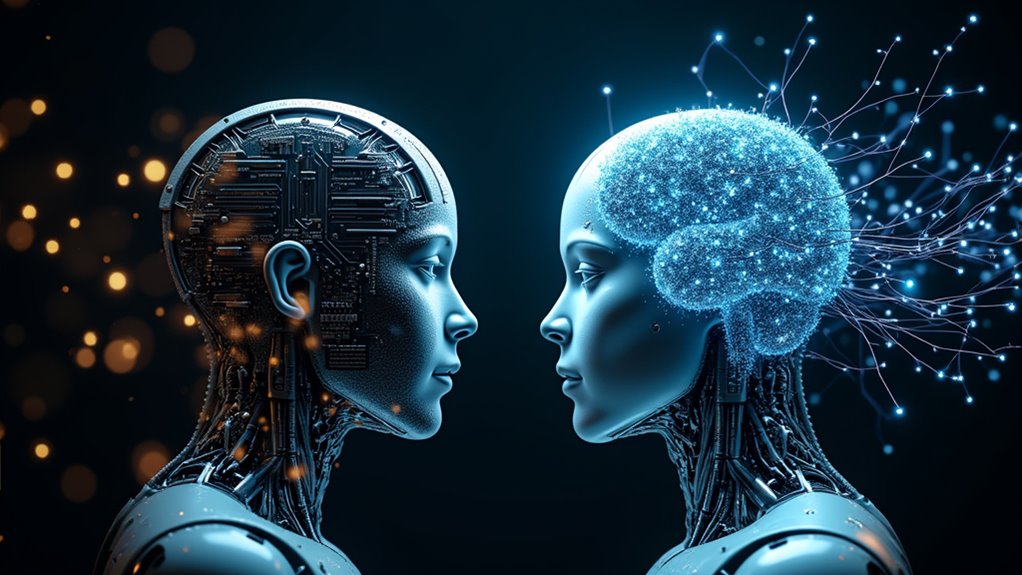
Deep learning, on the other hand, is machine learning’s overachieving younger sibling. It’s like machine learning went to the gym, got a PhD, and learned to think for itself. Using artificial neural networks inspired by the human brain, deep learning tackles the really tough stuff – we’re talking self-driving cars, voice assistants that actually understand you, and medical diagnostics that could save your life. Customer service has seen remarkable improvements with tools like AI copilots enhancing agent performance and decision-making capabilities. The network’s sophisticated activation functions enable complex pattern recognition across multiple processing layers.
Deep learning: the brainy powerhouse that makes machines truly smart, turning sci-fi dreams into everyday reality through neural network magic.
Here’s the kicker: deep learning is incredibly data-hungry. While machine learning can get by with modest amounts of data (think thousands of examples), deep learning needs millions of data points to really shine. It’s like comparing a casual jogger to an Olympic athlete – both are running, but the training requirements are worlds apart.
Machine learning is perfect for simpler tasks like spotting spam emails or suggesting which movies you might like. It’s faster to train and doesn’t need a supercomputer to function.
Deep learning, however, is the heavyweight champion when it comes to handling unstructured data like images, voice, and text. It’s more complex, more powerful, and yes, more resource-intensive.
The real magic of deep learning lies in its ability to figure things out on its own. While machine learning models need humans to identify important features in data, deep learning just needs raw information – it’ll figure out the important parts all by itself.
It’s like having an employee who not only does the work but also figures out the best way to do it. Pretty impressive, right? Though let’s be honest – sometimes using deep learning for simple tasks is like using a sledgehammer to hang a picture frame.